
Last Minute Tickets

Designing a last-minute ticketing experience that drives urgency and conversion
Role: Product Designer
Duration: ~6–8 weeks
Platform: Mobile App
Scope: UX Strategy, UI Design, Prototyping
Problem
Every day, a significant portion of event tickets go unsold, representing lost revenue for venues and missed opportunities for users.
At the same time, users who are open to spontaneous experiences struggle to:
- Discover relevant events happening now
- Trust last-minute ticket platforms
- Make quick decisions under time pressure
- Navigate cluttered booking flows
In fact, up to 20% of tickets can remain unsold due to poor distribution and discovery.
Most ticketing platforms are built for planned purchases, not impulsive, last-minute behavior.
Goal
Design a mobile experience that turns last-minute ticket buying into a:
- Fast and frictionless process
- Trustworthy and transparent experience
- Emotion-driven decision moment
- High-conversion flow
My Role
I led the end-to-end product design, including:
- Problem definition & UX strategy
- User flows and interaction design
- Visual system and UI execution
- Prototyping and iteration
Key Insights
From analyzing user behavior and ticketing platforms:
- Last-minute users are decision-driven, not research-driven
- Speed and clarity matter more than depth
- Trust is critical when purchasing under time pressure
- Users respond strongly to urgency + scarcity cues
“If it takes too long, I just give up.”
Product Strategy
I reframed the experience around:
1. Urgency-driven design
Help users act quickly without friction
2. Instant clarity
Surface the most important info immediately
3. Confidence in purchase
Reduce hesitation through trust signals
Solution
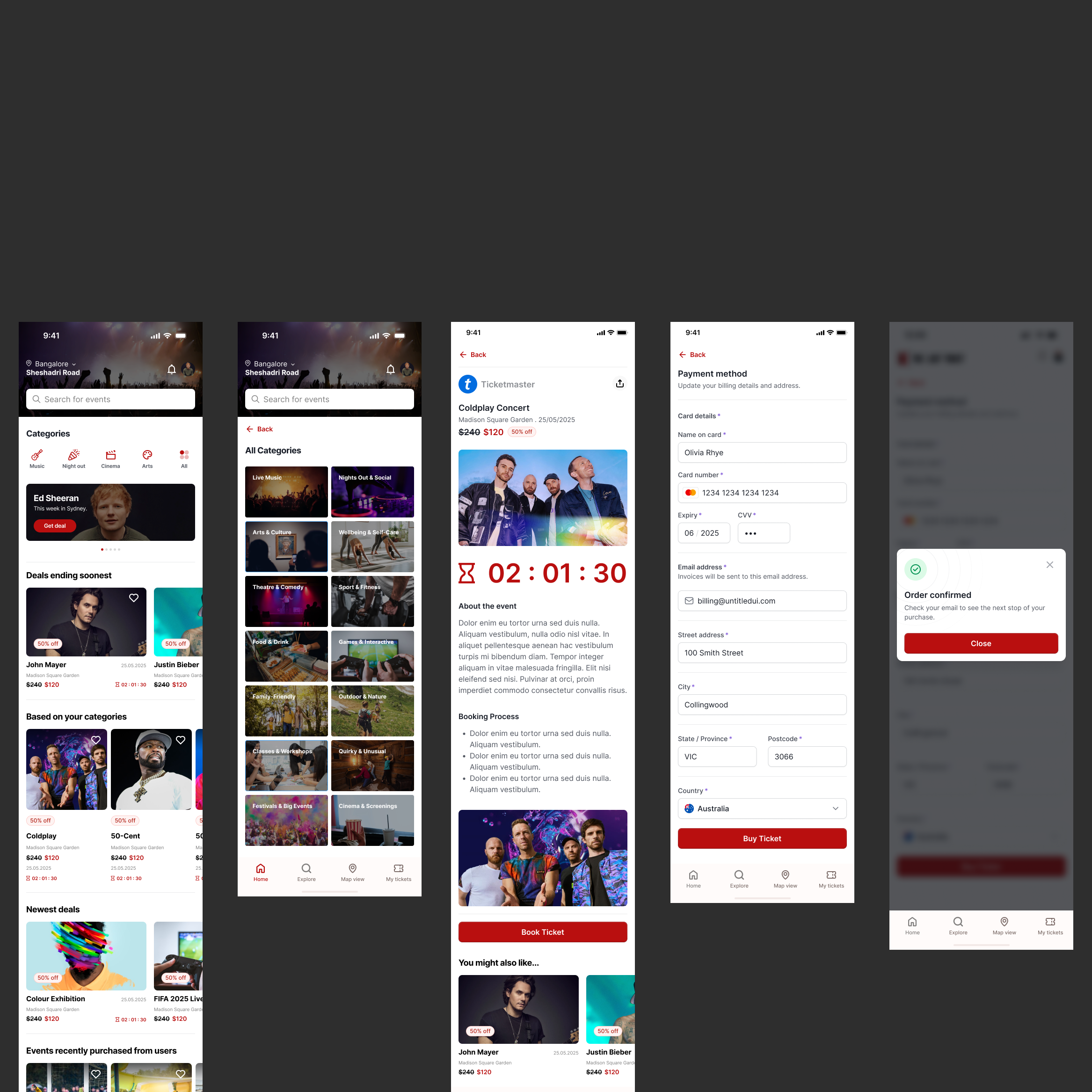
1. Real-Time Discovery Experience
- Live ticket availability
- Dynamic pricing for last-minute deals
- Location-based event suggestions
Helps users instantly find relevant options
Real-time inventory is critical in these platforms to ensure accuracy and confidence when booking.
2. High-Conversion Event Cards
- Clear pricing and discount visibility
- Time-sensitive indicators (e.g. “Starting soon”)
- Visual hierarchy focused on decision-making
Reduces cognitive load and speeds up choices
3. Simplified Booking Flow
- Reduced steps from discovery → purchase
- Minimal input required
- Fast checkout experience
Designed for impulsive behavior, not planning
4. Trust & Reassurance Layer
- Clear refund and ticket validity info
- Purchase feedback (loading states, confirmations)
- Post-purchase actions (add to calendar, directions)
Builds confidence in high-pressure decisions
Platforms that improve trust and reduce friction see significant increases in engagement and repeat purchases.
UI & Design System
The interface was designed to feel:
- Dynamic and engaging
- Clean but high-impact
- Focused on key decision points
Design choices:
- Bold typography for pricing and urgency
- Contrast-driven hierarchy
- Modular card-based system
Validation & Iteration
Through prototype testing:
- Users made faster decisions
- Reduced hesitation during checkout
- Improved clarity of event information
Simplifying ticket flows and reducing steps has been shown to significantly reduce drop-off and improve conversions.
Outcome
The concept delivered:
- A faster, more intuitive booking experience
- Increased likelihood of impulse purchases
- Reduced friction across the full journey
- A scalable foundation for real-time ticketing platforms
What I Learned
- Urgency is a design tool — not just a marketing tactic
- Reducing steps has a direct impact on conversion
- Trust becomes more important as decision time decreases
Next Steps
If taken further, I would:
- Validate with real user behavior and conversion metrics
- Introduce personalization based on past purchases
- Test urgency patterns (timers, scarcity signals) with A/B testing